MPs’ 14th of May debate on faith schools (abridged version)


On Monday afternoon,
the Education Secretary
answered questions on his response to the ‘Schools That Work
For Everyone’ consultation. Here’s a reimagining of how it could have gone.
Angela Rayner: Hi
Damian will you make a statement on (snigger) the “schools that work for”
(snigger) “schools that work for everyone “consultation?
Damiam Hinds: Why do people keep making fun out of that name? Anyway the highlights are more money etc. Also I’m doing a
U-turn on the 50% cap
on faith based admissions, but I’ll still be
lathering praise on faith schools.
Angela Rayner: I
don’t like grammar schools. I also just realised that if I’m going to keep tweeting
about #EducationNotSegregation
I should probably mention faith schools. If you’re sure you’re giving up on the
cap how much money are you putting into these new voluntary aided (VA) faith schools, how many
will there be and where?
Damiam Hinds: I’ll answer your questions on Grammar schools, say
that we want more partnerships with independent schools and then shrug my
shoulders about the faith schools – I don’t know what’s going to happen.
….
Edward Leigh: I’m super upset that you dropped plans to scrap the
50% cap, the Catholic Education Service who are pretty
much
the only people who supported this are also upset. The cap is “totally
ineffective” – if you ignore
the evidence
that it is at least marginally effective – and “Catholic
schools are the most diverse, the most inclusive” – as long as we ignore all
their problems with religious and social economic selection, don’t mention any
of that homophobic
teaching
and are super careful about what comparisons we
use
. Plus you
used to be my buddy on this
, you were all for letting Catholic schools
practice 100% discrimination in admissions. What is it about becoming Education
Secretary
and having to look at this policy in more detail that keeps
making people support the cap? If new Catholic faith schools are to be VA
schools, they’ll have to put up a little money, and those pesky local
authorities may prefer inclusive schools instead and we can’t ride roughshod over them like with academies. “This is a disgraceful
announcement.”
Damiam Hinds: I love faith schools. Schools that are able to
practice indirect social economic selection get slightly – and I mean
very very slightly
– above
average results. I know the Catholic Education Service had the biggest
temper tantrum when they couldn’t open 100% discriminatory academies, but come
on I’d look pretty
silly
introducing more segregated schools when I’m also promoting the
integration strategy.
Desmond Swayne: “What argument persuaded the Secretary of State to
drop the manifesto commitment on the cap for free schools?”
Damiam Hinds: I was a bit tired of no one agreeing with me. My two predecessors told me it was silly,
majorities of every major religion and belief group were against it, everyone
from Ofsted to Ted Cantle, and our own integration tsar, pretty much everyone was
against it. And the No More Faith Schools campaign had these great
bright placards
you can download from their website. So I came up with a
convoluted plan to open more VA schools.
Crispin Blunt: Thanks for keeping the cap. It would have been
really awkward talking about “the importance of integration and community
cohesion” if we didn’t. But hang on a minute, if religious groups can chip in
about 1% of the long term budget and then practice 100% discrimination in
admissions – not to mention employment and confessional RE – how’s that going
to “ensure integration and community cohesion”.
Damian Hinds: If the Catholic Education Service can fund
my intern
they can fund a VA school. Voluntary Aided schools have been
around longer than we’ve been alive mate. I’m sure if allowing faith groups to
run, discriminate and proselytize in publicly funded schools wasn’t great
for community cohesion, someone
would have mentioned it
.
Andrew Jones: I’ve got lots of faith schools in my neck of the
woods and they are great. Also, if we ignore the religious discrimination and families
who are given no option other than a
faith school, they’re great for
choice
.
Damian Hinds: Yeah if we ignore those inconvenient facts then we can say faith schools promote choice. I
mean choice is the most important thing, that’s why we have race based and
political party based schools as well… right? Also if we ignore the fact that only 5%
of parents choose their school based on it grounding pupils in a faith
tradition, and that the vast majority just want a good local school, we can keep
spreading the myth that faith schools are good for choice.
Michelle Donelan: Are you still considering changing the cap is
there any room for moving it up or down a bit?
Damian Hinds: “We keep all policies under review”. But seriously I
doubt I could get away with a U-turn on my U-turn, faith groups will just have
to open VA schools if they want to keep out the infidels. Also we ask academies
to pinkie swear they will be inclusive even if they are organised around a
specific religion.
This
is a satirical article – obviously the MPs didn’t actually ask/answer the
questions this way. This article is not affiliated with endorsed or approved by
any organisation. However if you want an education system free from religious
control, you might want to follow the #NoMoreFaithSchools campaign.
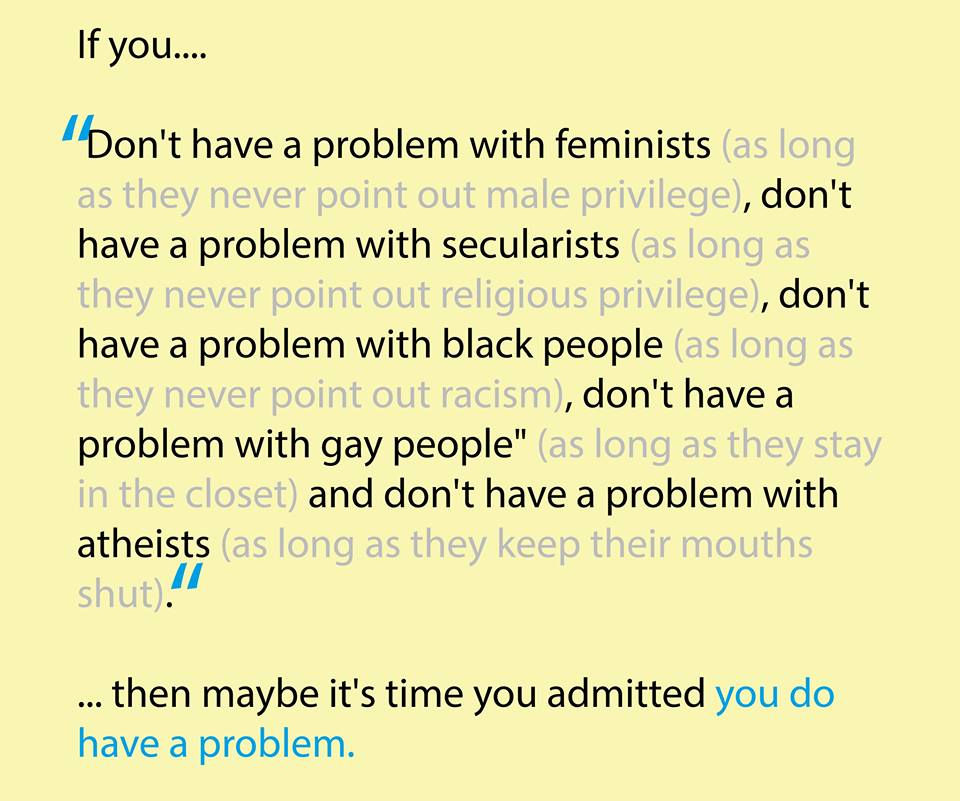
 

“I have no problem with women as long as they stay in the kitchen”

For the satire impaired I should point out that this isn’t a blog doesn’t form part of the barefoot, pregnant and chained to the stove manifesto. I’d momentarily considered calling it “Angry black men, feminazis, loud gays and aggressive atheists” but a) that was a bit long and b) could leave me falling victim to Poe’s Law. I also considered “Of course I support equality… but not too much”.
Members of privileged groups (and non-members who have internalised privileged ideas) who, actively or passively, maintain that privilege are often accommodatable with members of marginalised groups as long as they play the marginalised role they are expected to and do not challenge the privilege.
Recently after a particularly infuriating Twitter discussion with a supposedly liberal and tolerant Christian I decided that this was a form of argument I just could no longer put up with. I’d had this blog idea for quite a while but I wanted something to just say “I’m leaving this conversation. It’s obvious that your privilege blindness is inhibiting your reasoning and I have neither the energy or inclination to try and talk you around it.” My idea was that I’d have this as a stock image and to go too when I just couldn’t be bothered. I put it together so quickly it had a weird typo in it.
The gray text is what the people objecting to the privilege being challenged really mean.
Whether I’m standing up for feminism, secularism, anti-racism, LGBT equality or atheism this is the number one opposition I experience in one form or another. It’s an attempt to make oneself seem reasonable by reinforcing the idea of their privileged position being the natural/correct position and to marginalise their opposition.
Of course, an individual feminist/secularist/anti-racist/LGBT-ally may indeed be obnoxious or aggressive, but that’s not really what this objection is about. To some people (and I’m not just talking about frothy mouthed caricatures) the very idea that someone exists who challenges their view of what is natural/correct is deeply disturbing or offensive.
On a related note readers may be interested in a paper published in the the Journal of Psychology last year on “the Myth of the Angry Atheist”. It comprised of 7 studies which showed that (1) Americans view atheists as stereotypically angry and angrier than other minorities and (2) that there was no evidence that this stereotype was accurate.
We should resist allowing erroneous accusations of anger to be used to marginalise groups or social justice movements. However it’s also important to defend anger as a legitimate and in some cased constructive response to injustice. My feminism, secularism, anti-racism, support for LGBT equality and atheism are not driven by anger. But I am angry when I see the harm done by sexism, by racism, by homophobia and by religious belief and more people should be.


An atheist does not always a secularist make

Despite atheism and secularism often being conflated there’s no reason a religious person can’t be a secularist. However there seems to be the assumption that being an atheist automatically makes one a secularist. But is this always true? Just as being non-male does not automatically make one a feminist, it seems that many atheists can be non-secular and even anti-secular

Atheism is defined as the lack of belief in gods.

Secularism in the sense that I use if is the rejection of religious privilege or the imposition of religious authority in the public sphere

Secularism like feminism (the rejection of gender privilege) is a subset of egalitarianism. Side note: this is why men’s rights activists sound particularly stupid when they say “I’m not a feminist, I’m an egalitarian.”

I could write a whole blog on why secularism and atheism are conflated but for now I want to briefly address three main reasons. Anti-atheist prejudice in the United States has led to many non-religious organisations calling themselves secular in an attempt to seem less threatening and associate themselves with a very American value. Anti-atheist prejudice can also explain why some religious people want to link secularism to a word they perceive as a pejorative, while in the Islamic world secularism is often conflated with atheism/apostasy.

Often members of a privileged group find it hard to imagine anyone else in the privileged group rejecting that privilege voluntarily. I find something similar whenever I comment on feminist issues online. Because my screenames have always been gender neutral, anti-feminist men tend to assume I’m female and respond with (in)appropriately gendered insults.

Finally many secular atheists tend to assume that other secularists are atheists as well. At a recent secular conference the assumption of a shared atheistic worldview from many of the speakers and audience members was particularly problematic given that a large theme of the conference was the stories of secularists of all backgrounds. Around the world religious individuals rejecting the imposition of religious authorities in their lives are some of the bravest secularists.

Atheist may not generally suffer the worst from the effects of religious privilege but they don’t generally benefit from its effects either. By comparison many members of religious minorities may suffer deeply from the effects of religious privilege but also experience some positives – at least for their own elites. As atheists would find their very existence at risk under almost any theocratic regime, most atheists have a practical reason to support at least some degree of secularism.

An earlier draft of this blog looked at some of the ways in which atheists may be anti-religious in a non-secular way. I decided to cut a lot of this as it is in any case an overly hyped problem and could distract by endorsing some of the ridiculous strawman secularists some religious leaders use to justify their own privilege.

Of course it is possible to be anti-religious and a secularist; just as it would be entirely consistent with feminism to wish either to a) end the social construct of gender as a means of ending gender privilege and promoting equality or wish to b) end gender privilege and inequality while preserving some form of gender as a social construct. It may be a secondary effect of secular policies (e.g. equality laws or good quality education) that certain religious views decline (e.g. homophobia or creationism). But if the intended purpose of a policy was to promote atheism then it would be hard to justify in a secular way.

I’ve cut out a longer exploration of this issue (although hope to explore it in a later blog on Humanism) to move on to a more interesting (and real) problem and one that is on the surface harder to explain. Why do many atheist seem to actively support at least some form of religious privilege. In trying to understand why this is we can draw on other examples which look at why members of an outgroup or marginalised group may support the privileges of an ingroup or privileged group.

First the most obvious is that atheists are not an automatically visible outgroup. We can confidently say there are atheists in the congregations, laity and priesthood of every single religion. Someone can be an atheist but still present themselves as a member of an ingroup in order to draw on the privileges of the ingroup. This is not always a deceitful tactic, as when a politician or priest feigns religious belief in order to have more influence and in so doing actively promotes religious privilege. In many places and times atheists have had to feign religious belief in order to enjoy the religious privilege of not being murdered or ostracised as an apostate and in so doing they passively support religious privilege. Of course there are many positions in between, just as a homosexual may conceal their sexuality in order to avoid discrimination an atheist could conceal their atheism to better fit in. Given that challenging religious privilege (secularism) is so conflated with atheism, many atheist passively or actively support religious privilege in order to avoid being labeled as part of the outgroup.

Secondly many atheist may simply not see religious privilege as that big of a problem for them. They could be very privileged in other ways (Bill Gates can probably insulate himself from the effects of religious privilege reasonably well) or they could be very marginalised in other ways that they are focused on dealing with more immediate forms of privilege, or someone may not realise how one form of privilege that is harming them is related to religious privilege.

Thirdly atheists may earn favour with (or appear less threatening to) religious people by supporting religious privilege. Turn on Fox News and you can find a person of color telling the audience how the black community is at least partly to blame for America’s race problems. Open the Daily Mail and you can find female writers railing against feminism. Openly atheist politicians in the UK go out of their way to praise the work of religious organisations and to support faith schools. E.g. the Deputy Prime Minister and theist Nick Clegg sends his children to a state funded highly socially selective faith school. Exercising this religious privilege is seen as acceptable whereas exercising his economic privilege by sending them to a private school would not be seen as acceptable.

This brings up a fourth reason. Different forms of privilege can act as a proxy for each other or be intertwined (intersectionality). Recently I spoke to a member of staff at a Church of England primary school. They wished to make their school less religiously selective. However parents at the school (at least some of whom had to have been atheist) were vehemently opposed. The reason? A less religiously discriminatory admissions criteria would make it easy for children from the newly constructed council estate to attend. The overwhelming evidence is that religiously selective schools in the UK are socially selective, they take (proportional to how many they would take in an equal admissions system) less poor children, less children who speak English as a second language, less children with complex needs.

Many middle class atheists support faith schools because by supporting this form of religious privilege they support their privilege of being able to get their children into a better more middle class school than their poorer neighbors.

There is another darker form of religious privilege acting as a proxy and that is in the identity politics of the British far-right. In these politics Christian is a proxy for White and many on the far right support Christian religious privilege as a way to support white privilege or anti-Muslim bigotry. For example Tommy Robinson the former leader of the EDL has said in interviews that he is not personally religious but he supports ‘Christian Nation’ identity politics. Atheists who support religious privilege by arguing against marriage equality would be another tiny example.

Fanfic and religion

What a conservative Christian’s choice to rewrite Harry Potter shows about fandom and religion

This week several newspapers reported that fanfic.net user ‘Grace Ann’, a conservative Christian, is rewriting Harry Potter to remove the magic and bring the story in line with her own values. Grace Ann has posted the first 7 chapters of her fic. All the reporting I’ve seen on this has been pretty disparaging of Hogwarts School of Prayer and Miracles. A bit of digging makes it look like the fic may be Poe but this is by no means clear.

As a liberal, an atheist and a Harry Potter fan, you might think I’d be against seeing one of my favorite pieces of fiction used in this way. But though I probably disagree with her values, I can imagine the appeal Grace sees in writing her own fic.

Even if Grace is a Poe, if she or other fans find the ideas and characters of the Harry Potter story valuable but have problems with other parts, then as a fans they’re welcome to reinterpret the work to reflect that. Just as when I read certain chapters I make mental adjustments to “fix” the original work’s objectively awful Quidditch rules.

Definition: “Fanfiction is when someone takes either the story or characters (or both) of a certain piece of work, whether it be a novel, tv show, movie, etc, and create their own story based on it.”

Fan fiction allows consumers of piece of fiction to take ownership of it. Fan fiction allows people to reinterpret an original work, to explore different themes or ideas and even to reimagine large parts of it to fit with their own values. This can include enhancing elements that the fan feels the original author(s) could have better explored.

What I do find interesting is the purported conversion of a pretty progressive work of fiction to make its values less progressive.

Take for example Hermione Granger; my interpretation of the character is as an important feminist hero in modern popular fiction. Grace Ann has apparently interpreted the character as “so different from the girls in public school who were focused on trying to be like the career women they saw on Sex And The City.”

My interpretation is more in line with the character in the book and my own values. But my interpretation, Grace’s interpretation, a million other fans’ interpretations  and even JK Rowling’s interpretation are all in their own way valid.

As long as we all understand we’re talking about a fictional character then there’s the potential to respect and debate each others interpretation. This possibility would not exist with someone who believed that the character was real, or who was willing to use violent or legal means to pressure me into accepting their interpretation.

This brings me to my central idea, that religion can be interpreted as a form of organised fandom. Most religions have a central conon with large mythical / fictional elements along with a host of other ideas and writings inspired by the central cannon. Appreciation for and interpretation of this cannon is a form of fandom which can heavily influence the lives of fans / followers.

If you were to ask most Christians in the West in 2014 to describe Jesus you’d get a very different interpretation of the character than you’d get in 15th century Europe. This interpretation would to varying degrees be based on some elements of the character as portrayed in the Bible while lacking or minimising other elements.

Over time different interpretations of characters become more or less accepted. For example almost all Christians today would say that Jesus opposed slavery. But Christians a few centuries ago may have been more likely to hold to an interpretation of the Jesus character in the Bible explicitly endorses it.

Some Christians would focus on the elements of the Jesus character which stress love and forgiveness. Others, just as validly, would interpret the Jesus character based on the elements that stress conservatism and obedience.

There are four are characteristics that healthy fandoms tend to have:

  1. Fans recognise when the object of their fandom is a work of fiction. But that works of fiction are valuable ways of exploring questions about reality.
  2. Fans recognise the validity of other fan’s interpretations. Despite disagreements, there’s no such thing as apostasy
  3. Fans recognise flaws in the original work and that the author(s) are not infallible.
  4. Fans’ enjoyment of a work is not reliant on forcing others to think the same.

Unfortunately religion, by in large, lends itself to an unhealthy form of fandom because it generally speaking fails these four characteristics.

The problem does not lie with the falsehood or immorality of large elements of the major religions. The problem lies with the inability of elements of the religion’s fans to honestly recognise this. The little moral worth we find in the Bible (and the larger amount of moral worth we find in other Christian inspired writing) would be more accessible, not diminished, if Christians could accept the fictitious nature of the Bible.

Religions’ fans divide themselves constantly over their different interpretations of Gods and holy books. Many religious parents exercise (and often expect the state to exercise) dogmatic control over their children’s education and experiences to try and ensure that they grow up with the ‘correct’ interpretation.

The process of religious reform would be far smoother and more fruitful if religions’ fans were to be more honest with themselves and others about the flaws in the religion. For example progressive Christians, Muslims and Jews who use religious arguments to support the equality of women and gay rights would be much better off just admitting that their holy books got these questions wrong, but that this doesn’t mean they got everything wrong.

Finally religious fandoms almost always seek privileged status. Not content to draw inspiration for themselves from religious ideas, the fans of religion believe that the laws and values of whole societies should also draw their inspiration from the same source.

Harry Potter and indeed most popular modern fiction is inherently more likely to lend itself to healthy fandoms than religious fiction. Its creator, characters and consumers are products of an enlightened society.

It is unlikely that anyone who has read a Harry Potter book is could possibly be as ignorant of the world as the authors of the Bible. Even if we except that the authors of the Bible made a genuine attempt to explain the world and morality to the best of their knowledge, they had the bad luck to be born when they were. Through no special talent of our own, Harry Potter fans have been born into an enlightened society and gained the skills to understand to various degrees and engage with a work of fiction.

TV tropes vs. skeptics

“You’re a bad person for not supporting my irrational beliefs.”

For a while now I’ve wanted to address some of the common tropes used to represent sceptics and atheists on television. The purpose of this is not to pick on isolated examples, I don’t think using stereotypes is always completely wrong and I don’t expect every representation of a group I identify with to always be positive. But, I want to address some common tropes which send harmful messages and maintain the social privileged position of certain irrational beliefs.

I’ve picked three examples here because they’ve all come up in some of my favourite sitcoms recently and annoyed me, not because of the individual storyline or characters but because of their underlying message.

The basic trope is this: Character A holds some irrational or Woo-based belief, which is not shared / wholly supported by Character B. Character B is represented as the bad-guy or closed-minded and by the end of the episode the audience is expected to feel either angry at Character B for their closed mindedness or sorry for them not having a sense of magic / imagination. Character A is usually female, because you know how those women are irrational, and magic pixie dream-girl’s only exist to teach rational men lessons.

Big Bang Theory S3E10: The Psychic Vortex

Penny reveals that she has cut her hair on the advice of her “psychic” Leonard cannot help but laugh at this objectively stupid idea. This breaks the social taboo on criticising (privileged) irrational beliefs and leads to an argument. Penny accuses Leonard of being closed-minded and belittling her. His desire to prevent someone he cares about being exploited by a charlatan is represented as “obnoxious”. Leonard is pressured to be “open-minded” by visiting the “psychic” but Penny refuses to be open minded enough to read a book sceptical of psychics Leonard suggesting this is again presented as “obnoxious”.

Raising Hope S4E19: Para-Natesville Activity

Virginia stops believing in magical things” and as a result becomes depressed and loses meaning in her life. Through various antics her husband Burt helps rekindle her belief in ghosts, eventually he also becomes a believer and this is meant to be seen by the audience as a positive outcome. Eventually the low income family decide to resume spending large amounts of money on the lottery. 

How I Met Your Mother S7E13: Tailgate

This at least bend the stereotype by making a male character the irrational one and a female one the sceptic. Basically Marshal has a large number of supernatural and conspiratorial beliefs that have been passed down from his father and he wishes to pass on to his and Lily’s child in order to ensure they have a sense of magic. Lilly confesses that she is jealous of Marshal’s farther teaching him to believe in “a magical universe” while her own absentee father taught her to “only believe in herself”. The audience are meant to feel sorry for Lilly for not believing in the stuff that Marshal does and happy that at the end of the episode the agree to raise their child with his beliefs.

This trope sends three negative messages. Firstly that believing in things without evidence is open minded, while basing your beliefs in evidence is closed minded. This attitude privileges credulity and socially stigmatises the sceptical.

Secondly it reinforces the idea that being disillusioned of false beliefs is always/mostly a negative experience. This can pressure sceptics not to challenge irrational beliefs and paints outspoken sceptics as bad people. This denies the vast range of positive experiences people can have through embracing reality and can leave many people afraid to challenge their own irrational beliefs.

Thirdly it sends the message that having a sense of wonder or magic requires holding irrational beliefs. This can cause people to cling to irrational beliefs rather than embracing the far grander magic of reality. It is also something that many sceptics (and in particular atheists) find insulting and demeaning. We are regularly socially shamed and told that we have something missing from our lives.

Each of these messages have real-world consequences which can range from the trivially annoying to the really quite hurtful and damaging. How patronising is it to be told by friends and strangers that there’s something missing from your life? Is it good for social pressure and not wanting to be stigmatised as closed-minded to protect bad ideas from criticism? Is the world made more magical by relationships breaking down because one partner want’s to protect another from being taken advantage of by charlatans?

I love sit-coms, I think they are a good way to explore life. I like good cooky characters and good surreal or supernatural storylines and making fun out of a sceptical or atheist character can be funny. But I don’t expect it to be lazy and I don’t expect it to be used as an excuse to shame or stigmatise people who base their beliefs on evidence.